
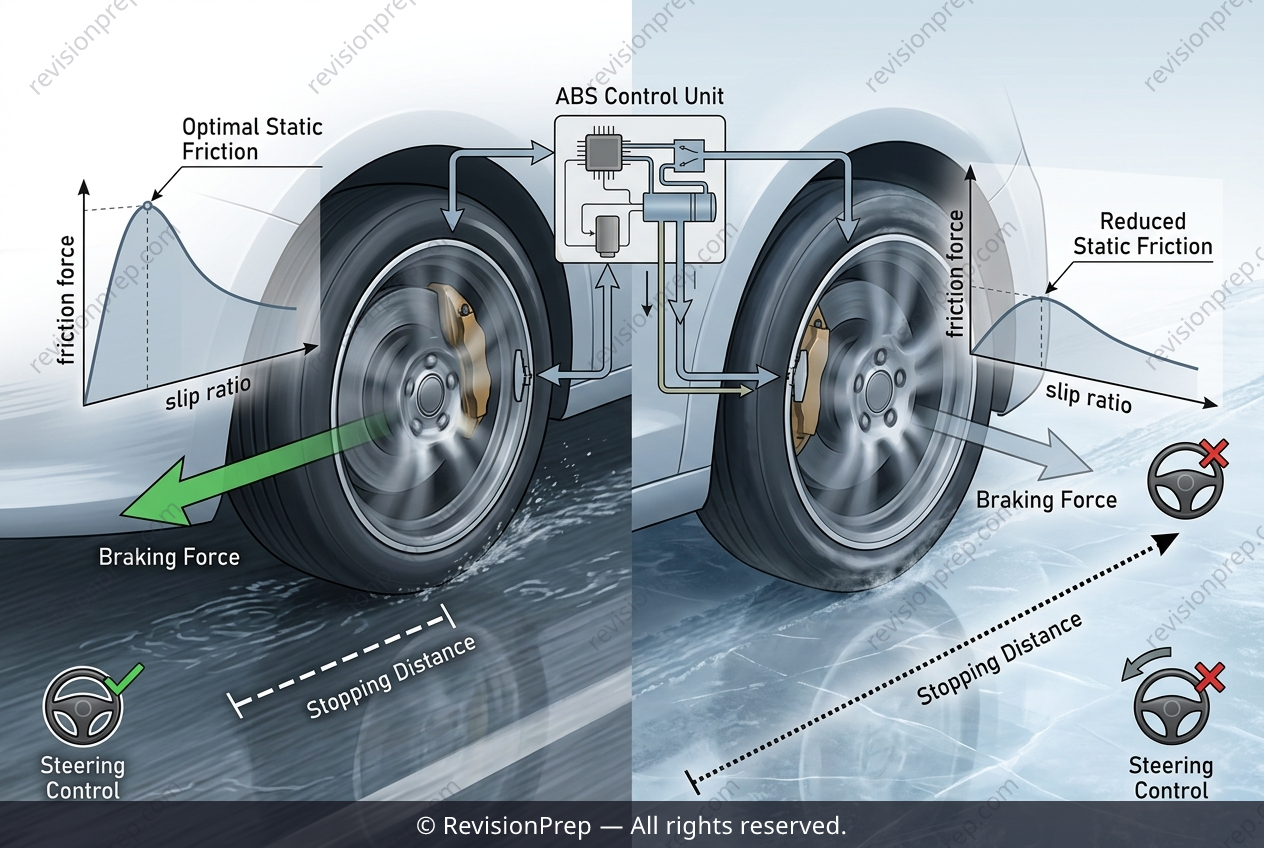
Physics: How Friction Controls Stopping Distance
Friction is the invisible force that decides whether a braking car stops safely or slides out of control. When a driver brakes, the tyres rely on friction between rubber and road to generate the force that slows the vehicle. That force depends on the normal force pressing the car onto the road and the coefficient of friction of the surface: F = μN, where N = mg. From this, deceleration follows directly from Newton's second law, a = F/m, so stopping distance scales with v²/2a. This matters enormously in emergency braking. Anti-lock Braking Systems use wheel-speed sensors to detect imminent lock-up and rapidly modulate brake pressure, keeping the wheel rotating so friction can still provide both braking and steering grip. On wet roads the coefficient of friction is modest; on ice it collapses, slashing the available braking force and deceleration, and stretching stopping distances dramatically while lateral control fades. Understanding how friction, normal force, and deceleration connect is therefore essential to grasping why active safety systems exist.
Start practising IB questions today
150,000+ IB-styled questions, criteria-mapped and instantly accessible.