
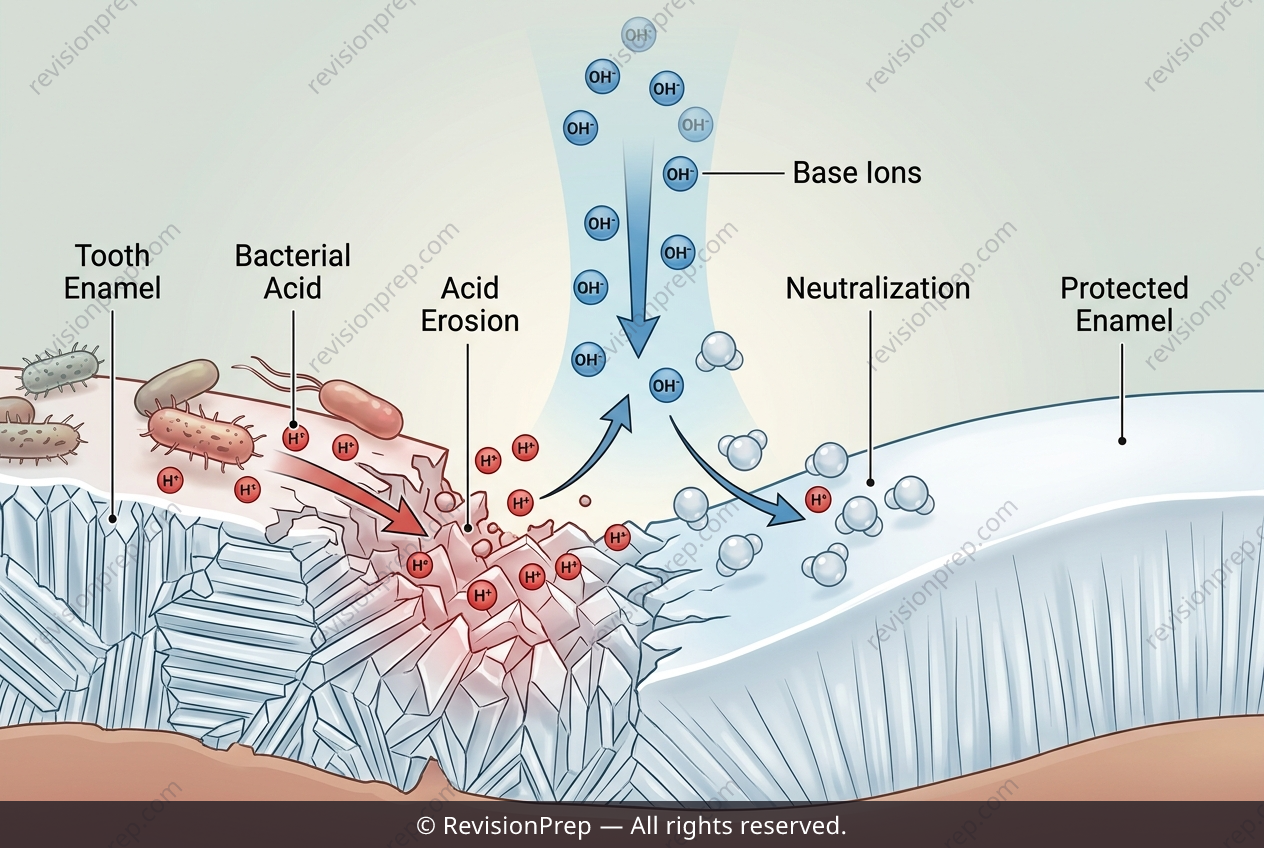
Chemistry: How Neutralisation Helps Prevent Tooth Decay
Acid-base neutralization is one of the most familiar applications of chemistry in everyday life, and it plays a surprisingly important role in oral health. Toothpaste is a carefully formulated mixture: sorbitol adds sweetness and moisture, hydrated silica acts as a gentle abrasive, carrageenan thickens the paste, and sodium fluoride strengthens enamel. Among these, sodium hydroxide (NaOH) stands out as the base, a substance that accepts protons and neutralizes acids. This matters because bacteria in the mouth metabolize sugars and release acids that attack tooth enamel. When acidity rises, the pH around the teeth drops, and enamel — largely made of calcium hydroxyapatite — begins to dissolve, leading to decay. A base such as NaOH counteracts this by reacting with the acids produced, maintaining a near-neutral pH and preventing enamel erosion. The underlying relationship is simple: acid + base → salt + water, and it is this neutralization that links the chemistry of the laboratory to the chemistry of a healthy smile.
Start practising IB questions today
150,000+ IB-styled questions, criteria-mapped and instantly accessible.