
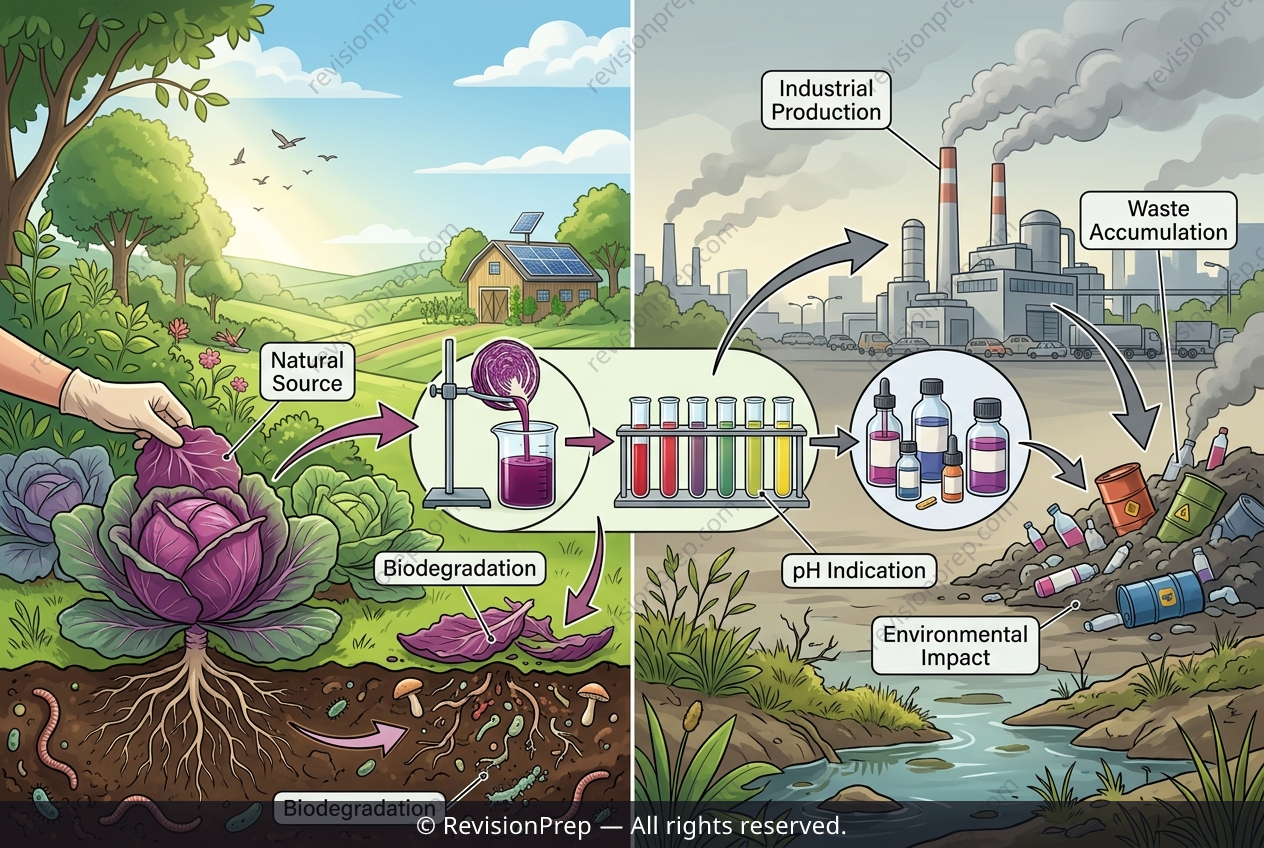
Chemistry: Litmus vs Red Cabbage - A Sustainability Test
Indicators are substances that change colour in response to pH, letting us judge whether a solution is acidic, neutral, or alkaline. In practice, that colour change is really a visible signal of proton transfer: an indicator molecule exists in two forms, one favoured in acidic conditions and one in alkaline conditions, and each form absorbs different wavelengths of light. The pH scale itself runs from 0 to 14, defined by pH = −log[H⁺], so a tenfold change in hydrogen ion concentration shifts pH by one unit. Choosing which indicator to use, though, is not only a chemical decision — it is an environmental one. Synthetic litmus paper depends on industrial manufacturing that consumes energy and produces chemical waste, and its disposal can leave persistent residues. A natural indicator such as red cabbage juice works on the same acid–base principle but is biodegradable, breaking down without contaminating soil or water. Comparing these two options shows how a simple laboratory choice connects molecular behaviour to real sustainability trade-offs.
Start practising IB questions today
150,000+ IB-styled questions, criteria-mapped and instantly accessible.