
Chemistry: Why Slow Neutralisation Delays Soil Recovery
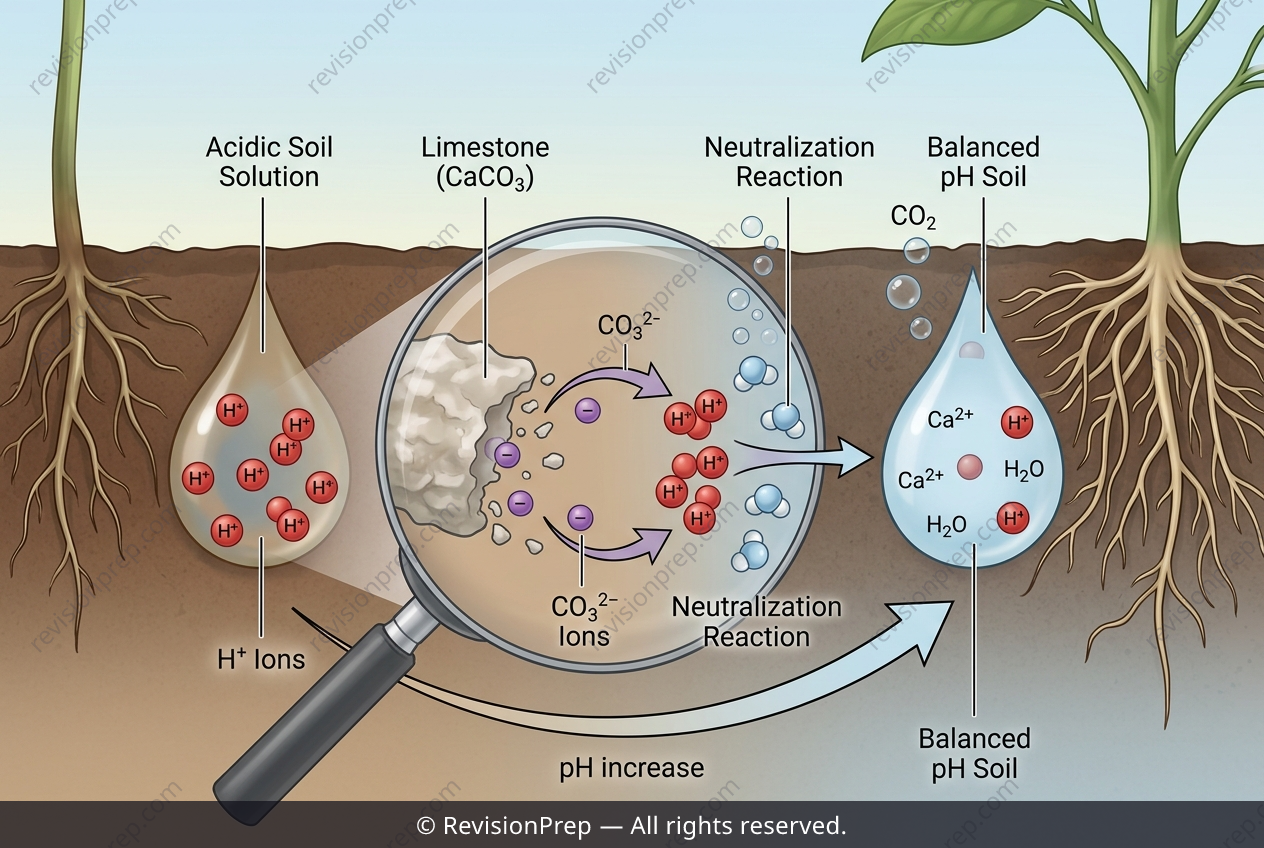
Soil pH is one of the quiet forces shaping whether crops thrive or struggle. When rain and repeated fertiliser use push pH below 6.0, essential nutrients become less available, and added limestone — calcium carbonate, CaCO3 — offers a chemical fix. As a base, CaCO3 reacts with the excess hydrogen ions (H+) that define an acidic soil, neutralising them and lowering their concentration. Since pH is a measure of H+ concentration, removing those ions shifts the soil back toward a more neutral, crop-friendly range. That single neutralisation step connects acid-base theory to real agricultural practice. Yet the chemistry also reveals its own limits: limestone dissolves and reacts slowly, so the rise in pH may take weeks or months to materialise. During that delay, crops can continue to suffer nutrient deficiency or acid damage, meaning the treatment's effectiveness depends as much on reaction rate as on the neutralisation itself. Understanding both the reaction and its pace is what makes this application worth studying.
Start practising IB questions today
150,000+ IB-styled questions, criteria-mapped and instantly accessible.