
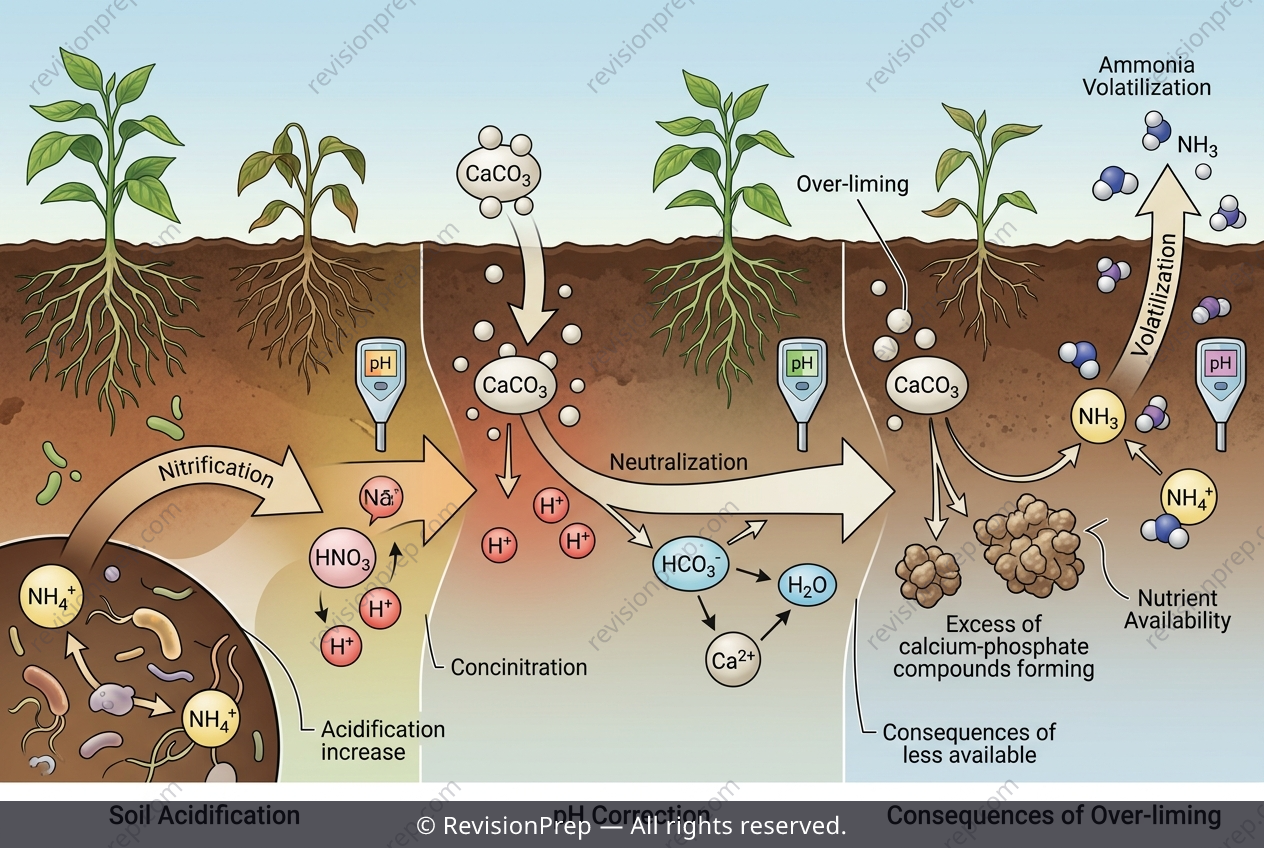
Chemistry: Why Too Much Lime Locks Nutrients Away
Soil pH is a master variable in environmental chemistry, governing nutrient availability, microbial activity, and crop health. When ammonium sulfate fertiliser is applied to alkaline soil, nitrification oxidises ammonium ions to nitric acid, gradually acidifying the soil — a process that can shift pH from around 8.0 down to 5.5 over several growing seasons. Restoring optimal conditions often means adding lime, calcium carbonate, which neutralises acidity and raises pH. The chemistry links stoichiometry to field-scale management: the pH change required, ΔpH, multiplied by the moles of calcium carbonate needed per square metre per pH unit, gives the total moles required, and multiplying by the molar mass of 100 g mol⁻¹ converts this to a practical mass. Yet liming is not without consequences. Over-application can push pH above 7.5, where iron, zinc, and manganese precipitate as insoluble hydroxides, locking nutrients away from crops. Excess lime also accelerates nitrification, and the resulting soluble nitrate can leach into groundwater or run off into surface waters, triggering eutrophication. Understanding these connected equilibria is essential for sustainable soil management.
Start practising IB questions today
150,000+ IB-styled questions, criteria-mapped and instantly accessible.