
Energy Forms and Transfer
GPE, KE, heat transfer, resources and efficiency — the five ideas MYP 3 exams always test
Quick facts
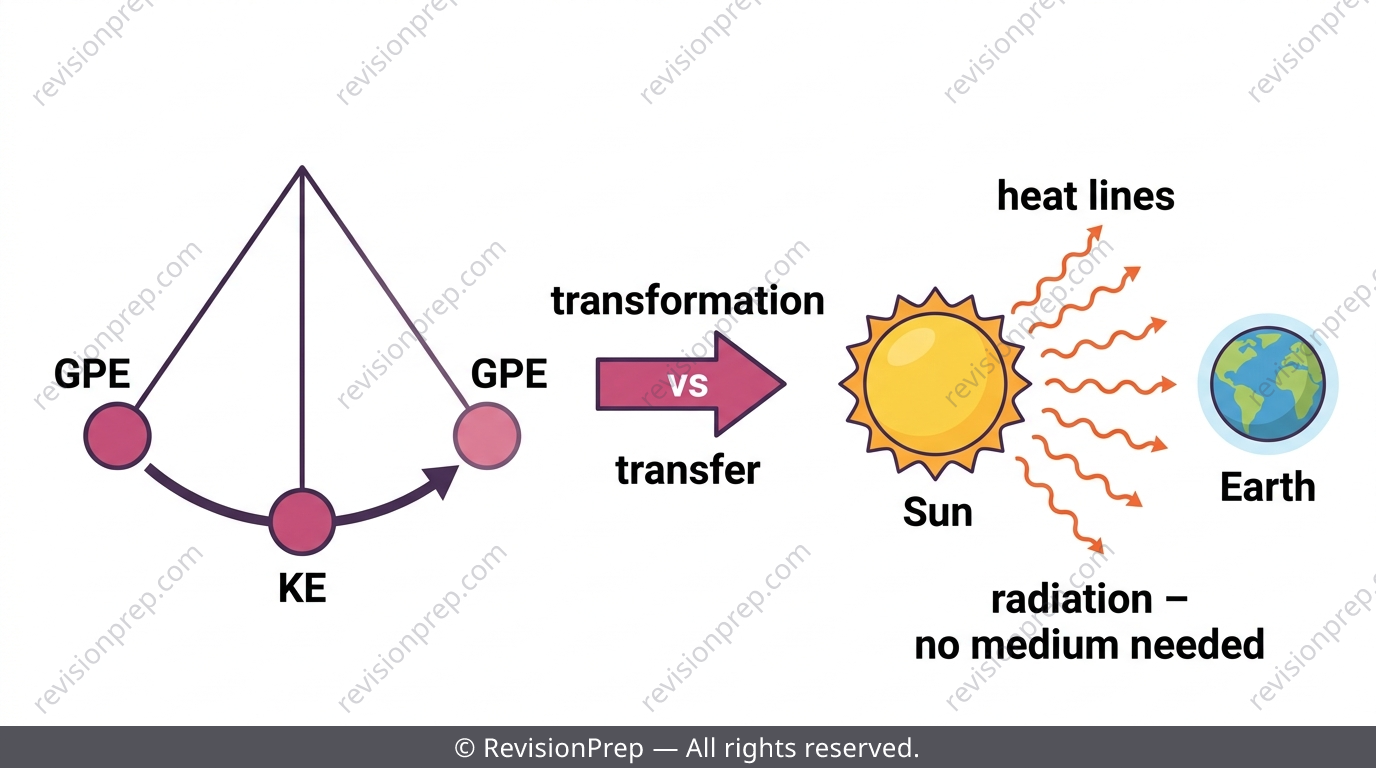
Energy Forms and Transfer is one of the most consistently tested units in IB MYP 3 Sciences, showing up every year in calculation questions on gravitational potential energy and kinetic energy, diagram-based heat transfer questions, and extended 'describe/explain' responses on conservation of energy. The whole unit rests on a single rule: energy cannot be created or destroyed, only transformed or transferred. Once that clicks, GPE-KE trade-offs, conduction vs convection vs radiation, renewable vs non-renewable classification, and why no device is ever 100% efficient all become logical consequences rather than separate facts to memorise. This teaser walks through the five ideas examiners return to most often, with the exact formulas, common mistakes, and phrasing examiners look for. For full worked examples, definitions, and practice questions, the complete MYP 3 revision notes are linked below.
What you’ll be able to do
Conservation of Energy: GPE ↔ KE
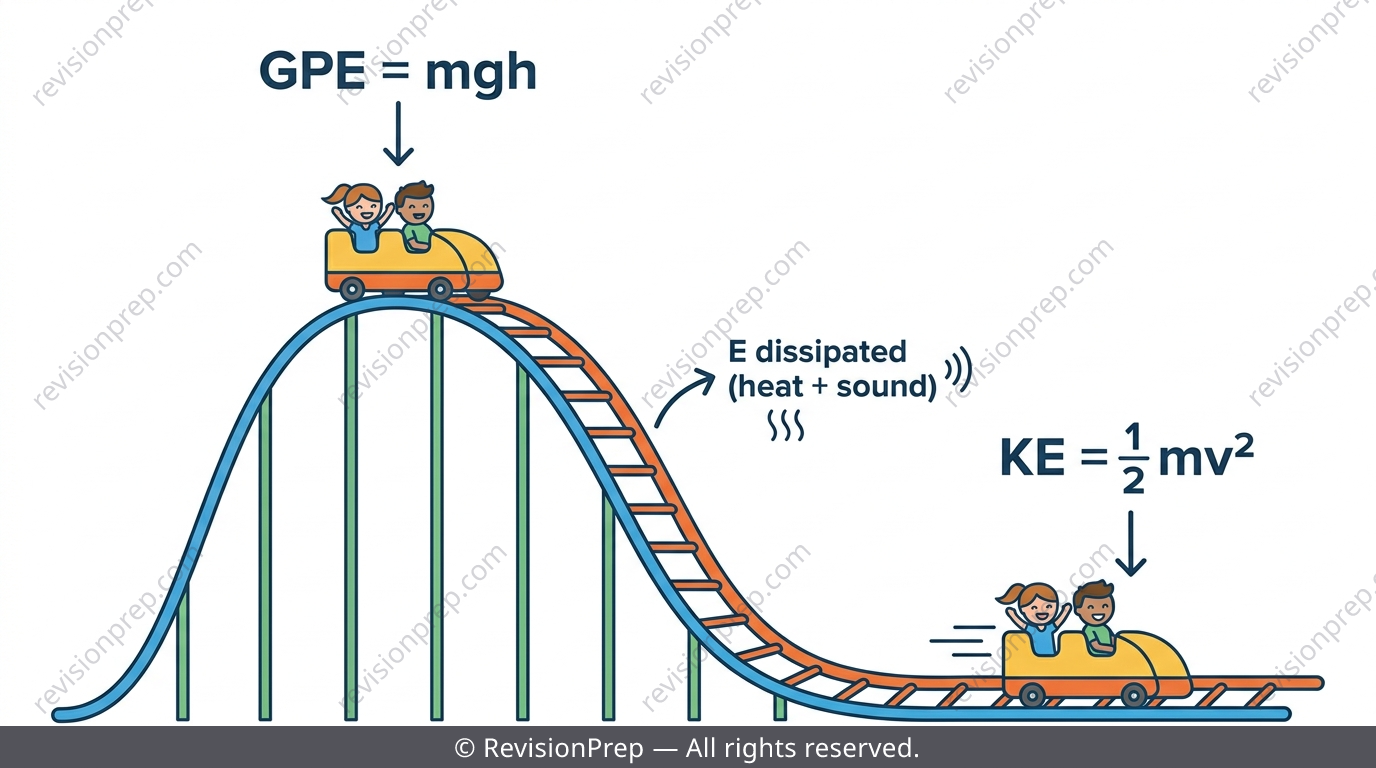
The Law of Conservation of Energy says total energy in a closed system stays constant — it only changes form or location. In a frictionless system, GPE lost equals KE gained exactly; in a real system, some mechanical energy dissipates as heat and sound, so . Height is always measured relative to a chosen reference point, usually where GPE = 0.
Exam tip
When two energy forms are named in a question (e.g. GPE and KE), you must explicitly link them with a word like 'converted' — writing 'GPE decreases, KE increases' as two separate facts often only scores half marks.
Common mistake
Expecting KE at the bottom to exactly equal GPE at the top and treating any gap as a calculation error — the gap is evidence of dissipated energy, not a mistake.
Mini summary
Mass cancels out of pendulum and free-fall motion — heavier objects don't swing or fall faster for the same height.
Transformation vs Transfer
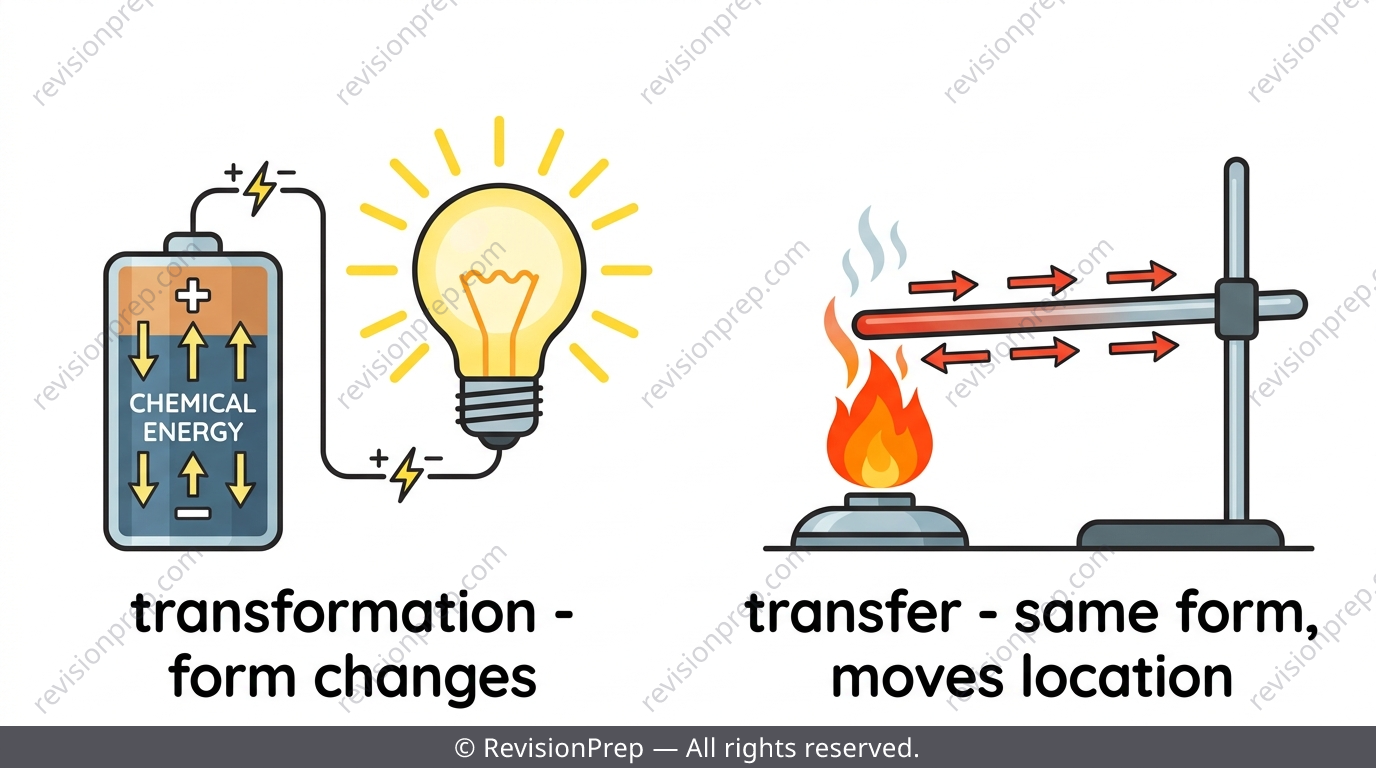
A transformation changes the form of energy, like chemical energy becoming electrical energy in a battery-powered device. A transfer moves the same form of energy from one place or object to another, like heat conducted along a metal rod. Real devices always waste some energy, almost always as heat and/or sound, which is exactly why no device is 100% efficient.
Mini summary
Ask: did the FORM change (transformation) or just the LOCATION (transfer)?
Conduction, Convection and Radiation
Thermal energy always moves from hotter to colder regions through one of three mechanisms. Conduction needs direct contact and a medium, working best in metals because free electrons carry energy quickly. Convection needs a fluid that can physically move, driven by density differences as heated fluid expands and rises while denser, cooler fluid sinks. Radiation is the only mechanism needing no medium at all — it's how the Sun's energy reaches Earth across the vacuum of space.
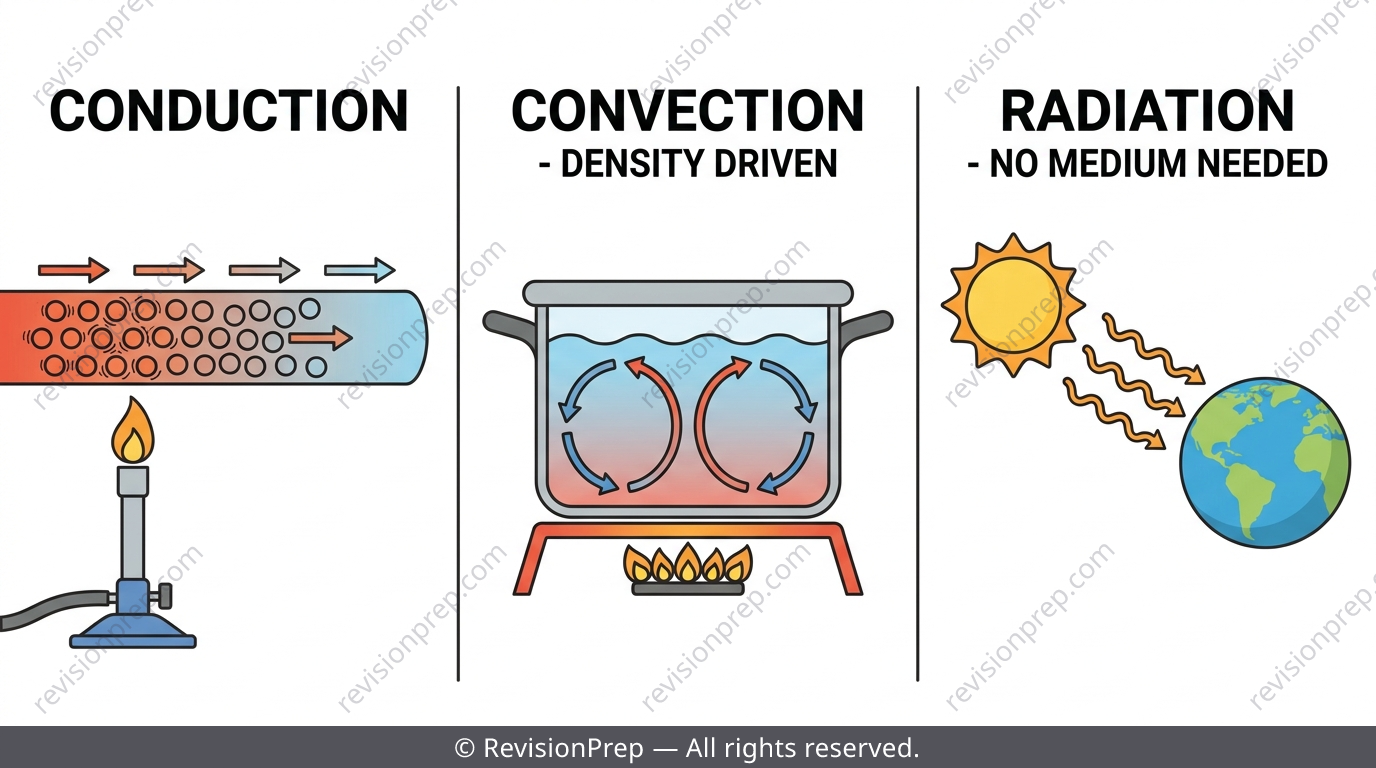
| Feature | Conduction | Convection | Radiation |
|---|---|---|---|
| Medium needed | Yes, solid | Yes, fluid | No |
| Mechanism | Particle collisions / free electrons | Bulk fluid movement (density) | Electromagnetic waves (infrared) |
| Best example | Metal rod heating | Boiling water, room heating | Sunlight through space |
Common mistake
Saying 'heat rises' as if heat itself moves upward, instead of explaining that heated fluid expands, becomes less dense, and is pushed upward by denser, cooler fluid sinking around it.
Mini summary
Dull, dark, matte surfaces absorb and emit radiation best; shiny, light surfaces reflect it and emit poorly.
Renewable vs Non-Renewable Resources
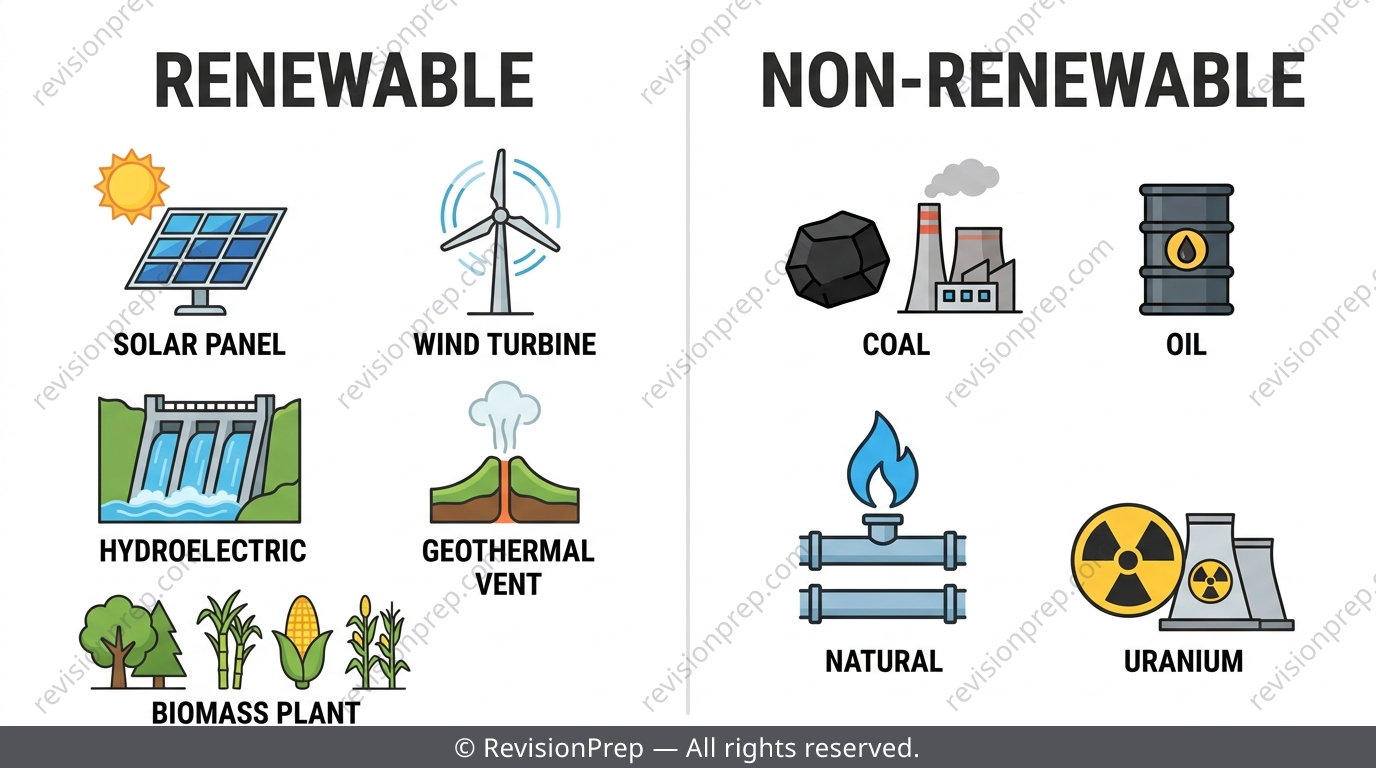
Energy resources are classified by how quickly they're replenished compared to how quickly they're used, not by how clean or efficient they are. Renewable sources like solar, wind, hydro, geothermal, and biomass are replenished naturally on a human timescale. Non-renewable sources like coal, oil, natural gas, and nuclear fuel exist in a fixed, finite supply that's used up far faster than it forms.
Common mistake
Classifying nuclear power as renewable because it doesn't burn fossil fuels — uranium is mined and finite, so nuclear is non-renewable despite low operating carbon emissions.
Mini summary
Classification depends on replenishment rate, not cleanliness — 'energy lost' always has a physical destination (reflection, radiation, conduction), never true destruction.
Energy Efficiency and Sankey Diagrams
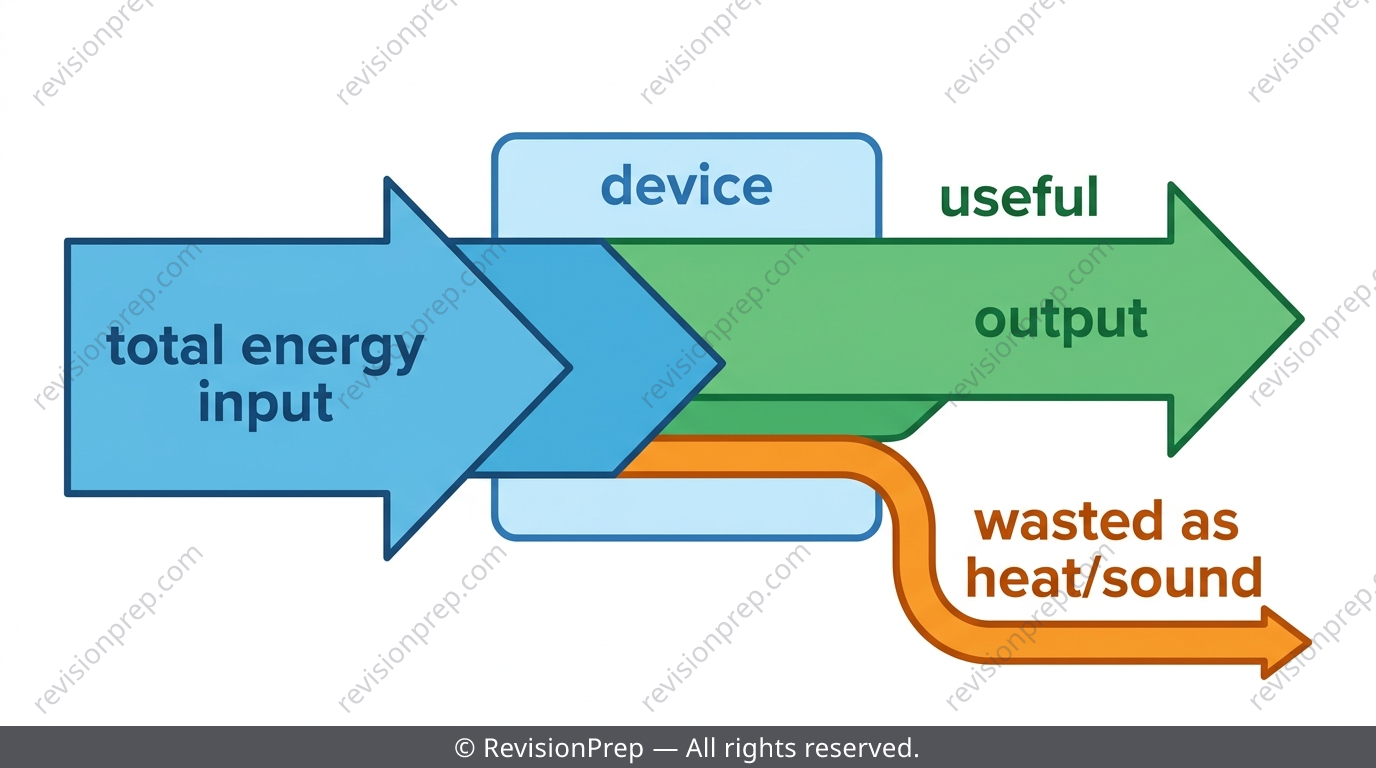
No real device converts 100% of its input energy into useful output — some is always wasted, almost always as heat or sound. Efficiency measures what fraction of the input becomes useful output, and it's a ratio, not an absolute quantity, so a device with a large useful output isn't necessarily the most efficient. A Sankey diagram shows this visually: arrow widths are drawn to scale, so a wider band represents more energy.
Exam tip
If asked to explain why a device 'loses' energy even though energy can't be destroyed, name WHERE the energy actually goes (reflection, radiation to surroundings, conduction losses) — don't just say 'it isn't 100% efficient'.
Mini summary
Efficiency = useful energy output ÷ total energy input × 100%.
Quick formula sheet
Practice questions
- Define the Law of Conservation of Energy in your own words.
- Name the three mechanisms of heat transfer and state which one needs no medium.
- Give two examples each of renewable and non-renewable energy resources.
- A 2 kg object falls from a height of 5 m. Calculate its GPE at the top (use g = 10 N/kg).
- Explain, using the correct mechanism name, why a metal spoon in hot soup gets warm quickly.
- Explain why nuclear power is classified as non-renewable even though it produces little carbon dioxide during operation.
- A ball starts with GPE = 400 J at the top of a slope and has measured KE = 350 J at the bottom. Explain the 50 J difference without saying energy was 'lost'.
- A solar heater absorbs 5000 kJ of solar energy but only delivers 3500 kJ to the water. Explain where the remaining energy goes and justify replacing an electric heater with this solar system.
- A student claims a heavier pendulum bob will swing faster than a lighter one released from the same height. Use conservation of energy to evaluate this claim.
Frequently asked questions
What is the difference between energy transfer and energy transformation?+
A transformation changes the form of energy, like chemical energy becoming electrical energy. A transfer moves the same form of energy from one place or object to another, like heat conducting along a rod.
Why doesn't KE exactly equal GPE in real pendulum or roller coaster problems?+
Friction and air resistance dissipate some mechanical energy as heat and sound. Total energy is still conserved, but useful mechanical energy is lower — this gap is expected, not a mistake.
Is nuclear energy renewable or non-renewable?+
Non-renewable. Uranium is mined and exists in a fixed, finite supply, even though nuclear power produces little carbon dioxide during operation.
Why does heat 'rise' in convection?+
Heat itself doesn't rise on its own — heated fluid expands, becomes less dense, and is pushed upward by denser, cooler fluid sinking around it, forming a convection current.
Why is efficiency never 100% for real devices?+
Every real device wastes some input energy, almost always as heat or sound, so the useful output is always less than the total input.
Does a heavier pendulum bob swing faster than a lighter one?+
No. Since both GPE and KE scale with mass, mass cancels out of the motion — bobs of different mass released from the same height and angle swing at essentially the same rate.
Master Energy Forms and Transfer for MYP 3
Related articles